Tag: Demographics

Africa and the Future of the Global Economy

Investment, Human Capital, and Strategic Partnerships in the 21st Century

Author: Dorcas Buzigire George
Founder & CEO, Primoveo LLC
March 2026

Africa’s demographic growth, strategic resources, and expanding markets will make the continent one
of the most consequential actors in the global economy over the next three decades.

Executive Summary

Africa is expected to become one of the most influential regions shaping the global economy in the
coming decades. United Nations projections suggest the continent’s population could reach
approximately 2.5 billion people by 2050, representing nearly one quarter of the global population.
Africa’s growing workforce, expanding consumer markets, and strategic mineral resources are
increasingly central to global economic discussions. At the same time, Africa faces significant
development challenges, including infrastructure gaps, governance constraints, and workforce
development needs. Strategic partnerships between governments, investors, development institutions,
and civil society organizations will be essential for unlocking the continent’s economic potential. This
policy brief highlights three pillars necessary for sustainable growth: human capital development,
responsible resource management, and strengthened governance institutions.

Key Takeaways

  • Africa’s population could reach 2.5 billion by 2050.
  • The continent will represent roughly one quarter of the global population by mid-century.
  • Africa holds major reserves of minerals essential for the energy transition.
  • Africa faces an infrastructure financing gap estimated between $68 and $108 billion annually.
  • International partnerships will be essential for sustainable economic growth.

Africa’s Demographic Transformation

Africa’s demographic expansion represents one of the most significant structural shifts in the global
economy. The continent has the youngest population in the world, creating both opportunities and
challenges. With the right investments in education, workforce training, and healthcare systems,
Africa’s growing labor force could become one of the most powerful engines of global economic growth.

Strategic Resources and Global Supply Chains

Africa plays a critical role in global supply chains linked to the energy transition. Minerals such as
cobalt, lithium, copper, and rare earth elements are essential for batteries, renewable energy
technologies, and advanced electronics. Responsible resource governance will be essential to ensure
that global demand for these materials also supports sustainable development across the continent.

Infrastructure and Investment Gaps

Despite its economic potential, Africa continues to face significant infrastructure constraints.
Investments in transportation networks, energy systems, and digital connectivity are essential to
improving productivity and enabling economic diversification. Closing infrastructure gaps will require
coordinated action among governments, development institutions, and private investors.

Governance and Institutional Capacity

Strong governance systems and institutional capacity are essential for sustainable economic
development. Transparent legal frameworks, predictable regulatory systems, and effective public
institutions create the conditions necessary for long-term investment and economic stability.

Key Challenges

  • Infrastructure deficits
  • Governance constraints
  • Climate vulnerability
  • Uneven access to education and workforce training
  • Geopolitical competition over natural resources

Policy Recommendations

  • Invest in human capital development through education and workforce training.
  • Promote responsible resource development and transparent supply chains.
  • Strengthen governance institutions and regulatory frameworks.
  • Expand international investment partnerships.
  • Invest in infrastructure and digital connectivity.

Questions for Policymakers and Investors

  • How can global partnerships support sustainable development while ensuring local economic
    benefits?
  • What strategies can accelerate investment in human capital development?
  • How can governance frameworks be strengthened to attract long-term investment?
  • What role should international institutions play in closing infrastructure gaps?

About Primoveo
Primoveo LLC is a Washington-based strategic advisory and business development platform focused
on strengthening economic partnerships between Africa, the United States, and Europe. Through policy
insights, strategic dialogue, and partnership development, Primoveo supports initiatives that promote
responsible investment, human capital development, and sustainable economic growth.
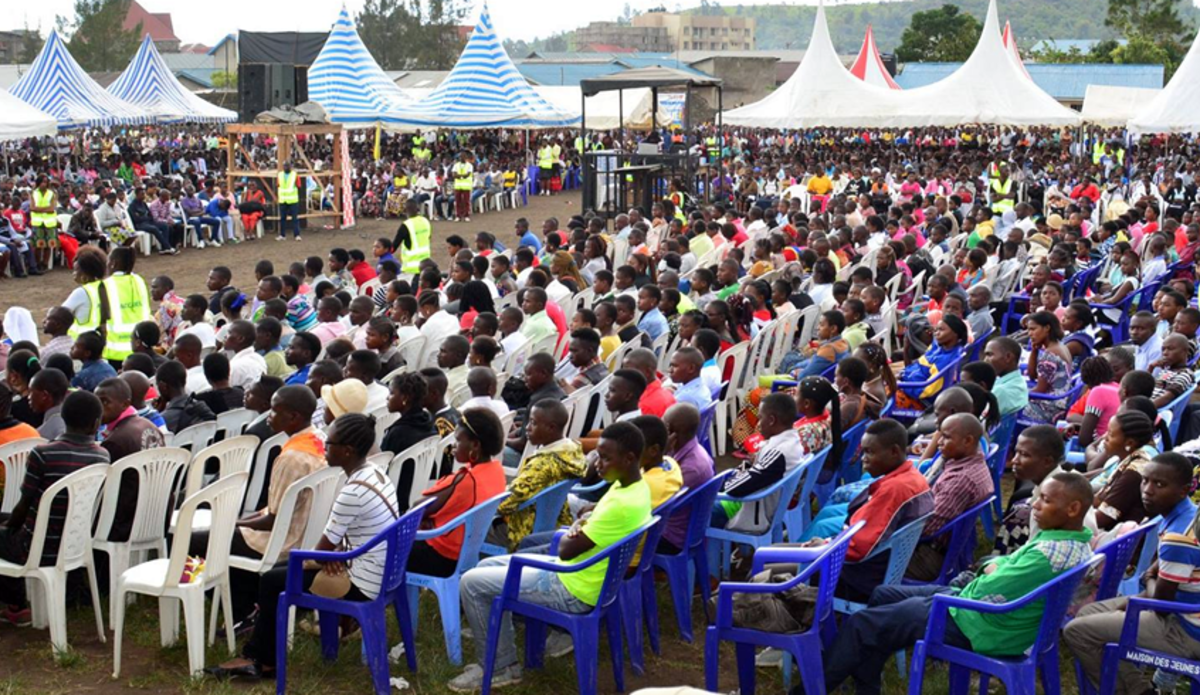
Youths gathering in Goma, eastern DRC, on the occasion of the 10th ICGLR Regional Multifunction Youth Forum (Ph. MONUSCO)

The DRC’s Demographic Trends – Powerhouse of Central Africa

Demographic Engine

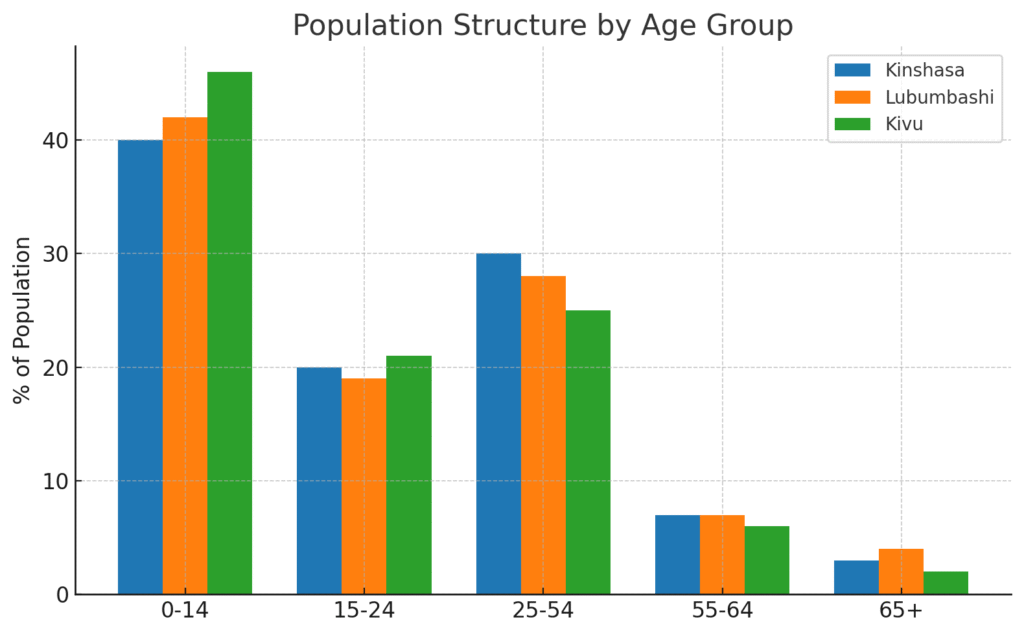
The Democratic Republic of the Congo (DRC) has one of the world’s fastest-growing populations. The UN puts the 2025 population at ~112.8 million, with an unusually young age structure: roughly 46% are under 15, and population would double in ~22 years if current growth persisted. The median age is about 15–16 years—among the world’s lowest. (United Nations Population Fund, DataReportal – Global Digital Insights)

Fertility remains high by global standards—nearly six births per woman on UN measures—which, combined with improving survival and urbanization, will keep the youth bulge large for decades. (UN WPP 2024 cites the DRC among the highest-fertility countries.) (World Population Prospects, World Bank Open Data)

Urbanization: where the demand concentrates

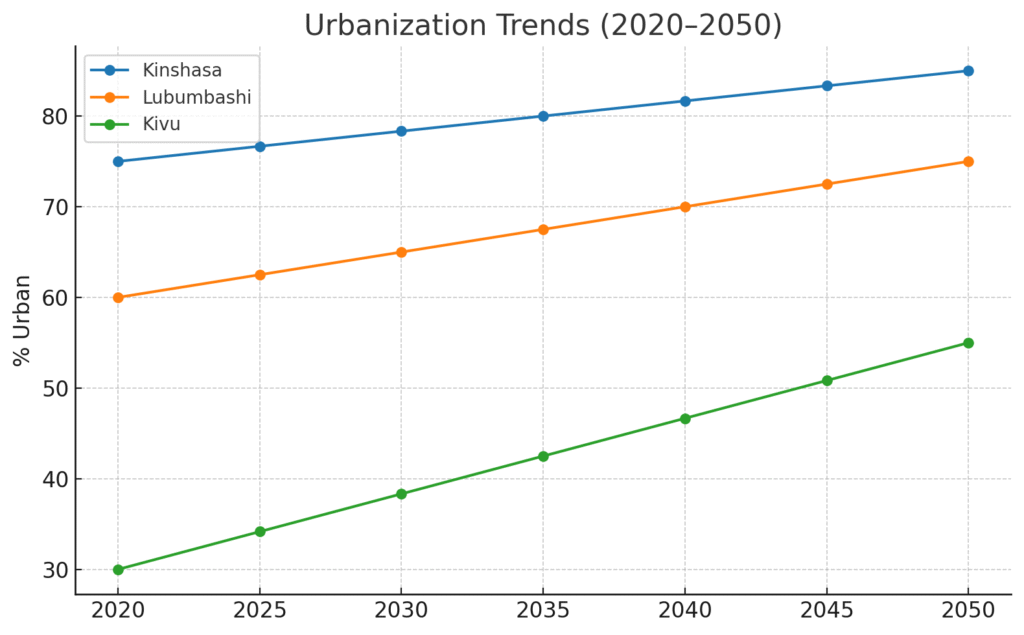
Urbanization is both rapid and durable. Around 48% of Congolese lived in cities at the start of 2024, and multiple UN/UN-Habitat briefs project a majority-urban DRC by mid-century—~60% urban by 2050 with a national population near 145 million. Kinshasa is already a megacity (~18 Million) and is frequently cited as potentially the continent’s largest in the 2030s, concentrating purchasing power in retail, housing, transport, and services. (DataReportal – Global Digital Insights, UN-Habitat, World Bank)

Education & human capital: progress with big gaps

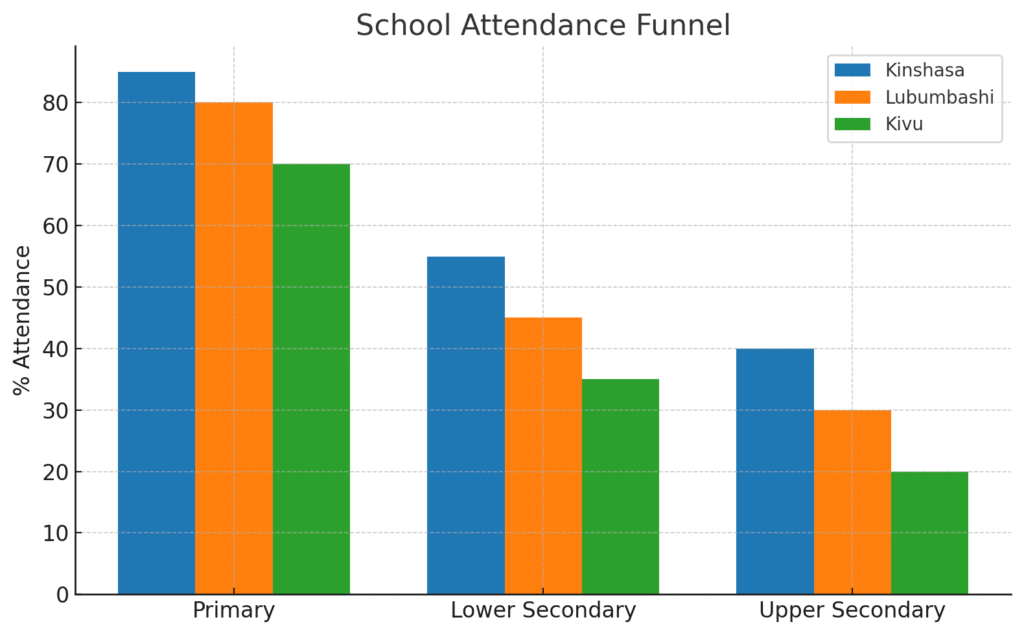
School participation has improved since the mid-2010s, but the pipeline narrows after primary grades. Primary completion reached roughly 79% for girls and 86% for boys (2021) on UNESCO’s UIS data. Yet attendance drops at higher levels: UNICEF reports ~78% primary attendance, ~32% lower-secondary, and ~34% upper-secondary (latest country dashboard). Adult literacy has trended upward to about 80% by 2022 on World Bank/UNESCO series. The picture is progress—but with sharp transition losses at the secondary stage that matter for tomorrow’s workforce quality and earnings. (iicba.unesco.org, UNICEF DATA, FRED)

Digital rails: the on-ramp to modern consumption

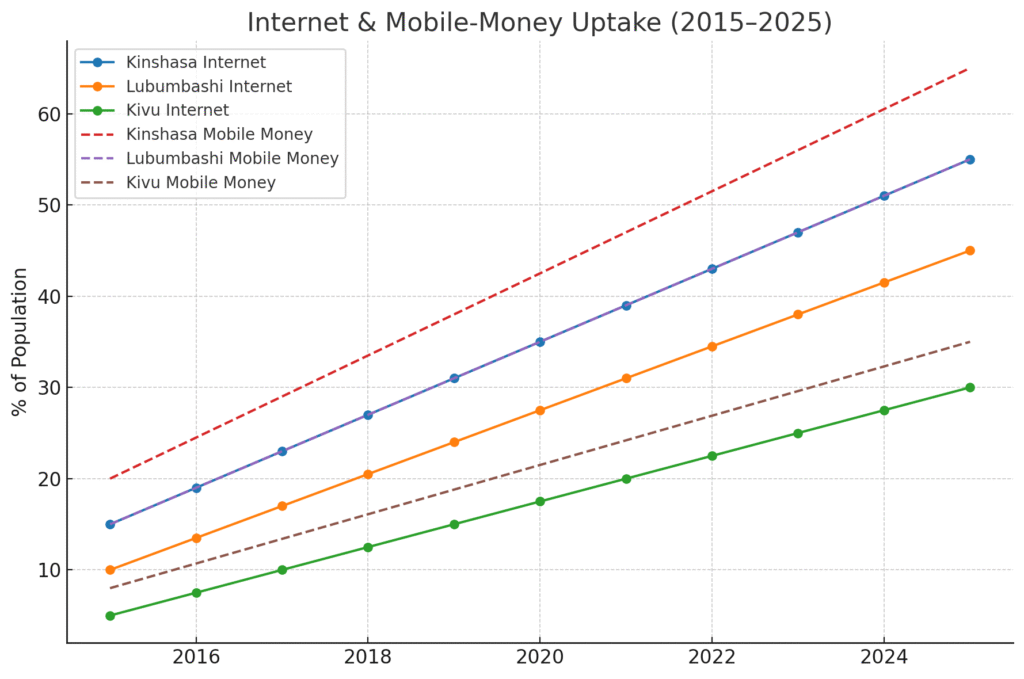
Connectivity is expanding quickly, creating distribution channels for everything from FMCG to finance and media. As of early 2025, the DRC had ~60.3 million active mobile connections and ~34 million internet users (≈31% penetration). Mobile money has surged too: the telecom regulator tallied 23.1 million mobile-money users in Q1 2024 (up from 18.2m a year earlier), deepening the rails for e-commerce, micro-credit, and bill payments. (DataReportal – Global Digital Insights, BANKABLE)

Today’s spending base—and why it can grow

Household consumption already drives the bulk of measured activity—~63% of GDP in 2023—typical of lower-income, commodity-exposed economies where private consumption is the core demand anchor. Still, purchasing power remains extremely constrained: the World Bank estimates ~73.5% of people lived under the $2.15/day extreme-poverty line in 2024, and recurrent conflict and displacement have elevated food insecurity (28 million facing acute hunger in early 2025). These headwinds shape the kinds of products that win—affordable, sachet-sized, and value-first—but also underscore the upside as incomes rise and stability improves. (TheGlobalEconomy.com, World Bank, Reuters)

How the consumer market is likely to evolve (2025–2035)

1) Youth-driven mass market, then a thicker lower-middle. The next decade brings tens of millions of new consumers into cities and into first-time formal markets (banking, ID’d SIMs, formal retail). Expect rising spend per capita first on essentials (staples, hygiene, basic health, telecom/data), then on “next essentials” (education, off-grid energy, transport, housing improvements). Global models (World Data Lab) point to a rising African consumer class; the DRC is a later but large entrant given its scale and urbanization trajectory. (World Economic Forum)

2) Urban retail footprints deepen. More organized retail in Kinshasa/Lubumbashi/Goma, expansion of proximity formats (minimarts, kiosks with digital inventory/float), and FMCG route-to-market modernization (DMS, e-ordering). Logistics players that can bridge port-to-city and city-to-neighborhood gaps will capture outsized value. (Urbanization sources above.) (UN-Habitat)

3) Digital leapfrogging continues. Low-cost Android, expanding 4G (and selective 5G) coverage, plus mobile money rails will push formalization: tuition and utility payments, micro-savings, pay-as-you-go solar, and BNPL-style school/health financing. Fintech/telecom bundles will keep ARPUs rising even at low ticket sizes. (DataReportal – Global Digital Insights, BANKABLE)

4) Education as a growth category. Continued demand for private low-cost schools, tutoring, exam-prep, and TVET—especially ICT, construction, logistics, and basic healthcare—given the big drop-off from primary to secondary and employers’ skill gaps. Providers that prove learning gains at low cost will scale. (UNICEF DATA)

5) Housing & neighborhood services. Urban growth fuels materials (cement, roofing, paints), basic fixtures, and community-level water/sanitation. Bundled services (e.g., solar + appliance financing; water kiosks + digital payments) can address affordability and cash-flow volatility. (Urbanization and poverty sources.) (UN-Habitat, World Bank)

6) Media & entertainment. A super-young, mobile-first audience will keep demand rising for short-form video, streaming bundles, sports, music, and gaming at ultra-low price points (ad-supported, telco-bundled, or community Wi-Fi). (Digital adoption sources.) (DataReportal – Global Digital Insights)

What could accelerate (or slow) the upside

  • Stability and macro management. Inflation and conflict are the big swing factors; easing either expands real disposable income and investable footprints. (Reuters)
  • Secondary education & skills. Raising transition and completion rates (especially for girls) would compound productivity and lifetime earnings. (UNICEF DATA)
  • Infrastructure & regulation. Power, roads, urban planning, and a predictable rule-set (for payments, consumer protection, and competition) are critical to scale distribution and reduce end-user prices. (World Bank/urbanization sources.) (Open Knowledge Repository)

Bottom line

The DRC’s consumer story is scale + youth + urbanization + digital rails—tempered by low incomes and fragility today. Over the next decade, the “mass market” should broaden in the biggest cities first, with steady formalization via mobile money and low-cost connectivity. Companies that design for affordability, solve last-mile logistics, and invest in skills and trust will be best placed to grow with the market as education outcomes and incomes gradually improve. (DataReportal – Global Digital Insights, UNICEF DATA)

Translate »